Email Us: info@startents.ae Call us: +971 50 660 1049
Star Tents Technical Contracting LLC logo
Temporary tent shelter for hot climates - Star Tents

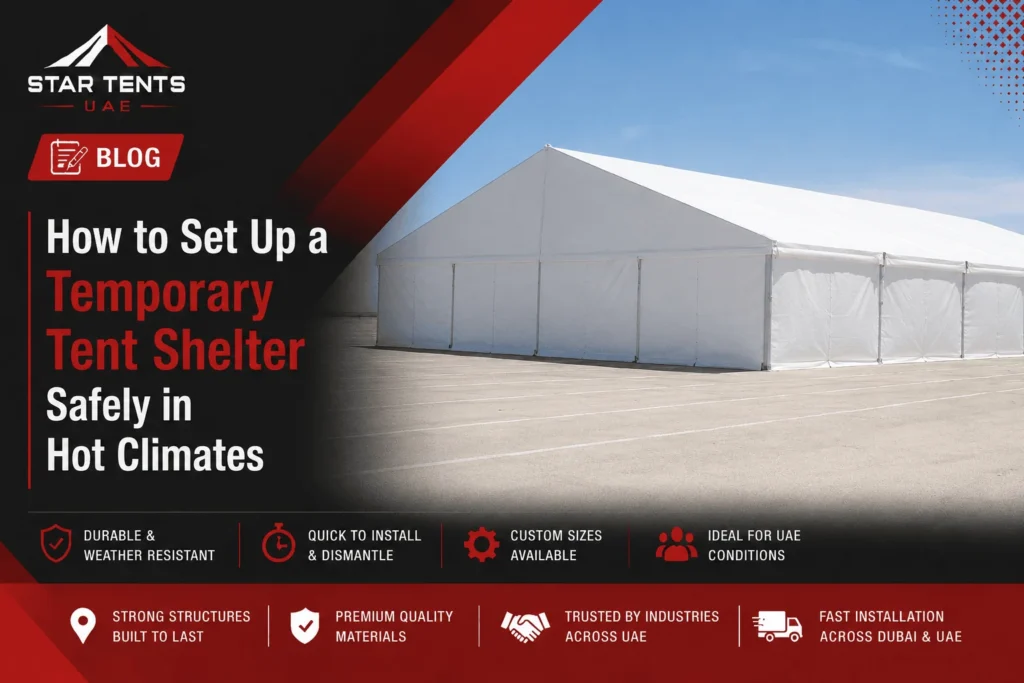
How to Set Up a Temporary Tent Shelter Safely in Hot Climates

Working or operating in the UAE’s extreme heat is not simply uncomfortable, it is genuinely dangerous. When summer temperatures on construction sites, outdoor events, and industrial yards routinely breach 45°C, the difference between a well-installed temporary tent shelter and a poorly erected one can come down to worker lives. Star Tents has spent more than 25 years helping businesses across the Emirates get this right. Whether you are deploying a labor rest shelter, a site canteen, or a large event structure, this guide walks you through every critical step — from site selection and fabric choice to ventilation, cooling, and MOHRE compliance — so your shelter performs safely through the harshest months of the year.

Why Heat Safety Matters When Choosing a Temporary Tent Shelter

The UAE’s Ministry of Human Resources and Emiratisation (MOHRE) enforces strict outdoor working regulations precisely because the risks of inadequate shelter are measurable and severe. Between June and mid-September, midday temperatures across Abu Dhabi, Dubai, and Sharjah regularly exceed 45°C, with humidity along the coast pushing the heat index even higher. A substandard shelter — one that traps radiant heat, channels wind incorrectly, or collapses under a sandstorm — transforms what should be a safe rest area into an additional hazard.

UAE Regulations You Need to Know Before Setup

Under MOHRE’s outdoor work ban (typically 12:30 pm–3:00 pm, June 15 to September 15), employers are legally required to provide adequate shaded rest areas for all outdoor workers. The shelter must be:

  • Sufficiently shaded to prevent direct solar exposure
  • Equipped with potable water and cooling facilities
  • Structurally sound and maintained throughout deployment
  • Compliant with any municipality-specific site permit requirements

Non-compliance can result in fines, site shutdowns, and significant reputational damage. Getting the setup right from day one is both a legal and moral obligation.

Step-by-Step Guide: How to Set Up a Temporary Tent Shelter in Hot Weather

The following six-step process covers everything from pre-installation planning through ongoing maintenance. Following these steps in order minimises risk, ensures regulatory compliance, and extends the working life of your structure.

Step 1 — Choose the Right Location and Orientation

Site selection is the single most impactful decision you will make. Even the best tent fabric cannot compensate for a poorly chosen position.

  • Orient the long axis east–west. This minimises the surface area facing the sun during the peak midday and afternoon hours, reducing radiant heat gain inside the shelter.
  • Avoid hard surfaces that retain heat. Concrete and tarmac absorb and re-radiate heat well into the evening. Position the shelter on compacted gravel or natural ground where possible, and consider laying a reflective groundsheet.
  • Use natural shade as a supplement. If existing structures, walls, or mature vegetation can provide partial shade on the south or west face during afternoon hours, position your shelter to benefit from them.
  • Ensure drainage. In the event of rare but intense rainfall, the site should allow water to drain away from the tent footprint rather than pool beneath it, which can undermine anchor points.
  • Allow clearance for air movement. Do not position the shelter in a hollow or against a wall on all sides. At least two open faces should allow prevailing wind to pass through.

Step 2 — Select the Correct Tent Fabric and Frame Material

Fabric and frame selection determine the long-term performance and safety of your shelter. The wrong materials will fail quickly in UAE conditions.

Fabric: Use UV-stabilised PVC with a minimum weight of 650 GSM for permanent or semi-permanent deployments. For temporary structures intended to last one to three months, 550 GSM PVC remains adequate provided it carries a recognised UV protection rating. All fabric should be independently certified as flame-retardant to at least NFPA 701 or equivalent international standard.

Frame: Hot-dip galvanised steel is the standard for UAE site shelters. It withstands sandstorm abrasion, resists corrosion in humid coastal environments, and handles the load combinations of wind, fabric tension, and occasional accidental impact. Aluminium frames are lighter and suitable for event and exhibition structures where rapid deployment and relocation are priorities, but they have lower yield strength under sustained wind loading.

Avoid untreated mild steel, which corrodes rapidly in the salt-laden coastal air of Abu Dhabi and Dubai, and basic polyester canvas, which degrades under UV exposure within weeks at peak summer.

Step 3 — Anchor Securely Against Sandstorms and Wind

Inadequate anchoring is the leading cause of shelter failure in the UAE. Do not treat this step as an afterthought.

  • Use ground anchors appropriate to the substrate. On compacted sand or gravel, helical screw anchors provide greater pull-out resistance than straight stakes. On concrete or paved surfaces, water-fillable ballast blocks or bolt-down anchor plates are required.
  • Calculate wind load for your structure size. As a baseline, structures over 10 metres in any dimension in open desert or coastal locations should be engineered for a minimum wind speed of 120 km/h. Consult your tent supplier’s load calculations.
  • Tension guy ropes at the correct angle. Guy ropes anchored at 45° from the tent edge provide optimal load distribution. Ropes anchored too steeply transfer force directly downward; too shallowly and they lose mechanical advantage.
  • Inspect anchor points after sandstorms. Sand ingress can loosen screw anchors and shift ballast blocks. After any significant wind event, re-check every anchor before allowing re-occupation.

How Star Tents Designs Temporary Shelters for UAE Conditions

Star Tents has been manufacturing and installing temporary tent structures across the UAE since 1998. Every shelter we supply for site welfare, construction, industrial, and event use is engineered specifically for the conditions described in this guide — not adapted from a product range designed for European climates.

Our UAE-specific approach includes:

  • Custom-sized PVC fabric at 650–750 GSM, UV-stabilised and flame-retardant as standard, not as a paid upgrade
  • Hot-dip galvanised steel frames engineered to UAE wind load requirements, with anchor specifications matched to ground conditions on your specific site
  • Double-skin insulated options for peak-summer deployments where cooling costs are a significant operational concern
  • MOHRE-compliant configurations covering shade coverage, cooling provision, and welfare facility requirements so your shelter passes site inspection from day one
  • Installation and maintenance support throughout the contract period, including post-sandstorm inspection visits

Whether you need a 20-person labor rest shelter or a 2,000 m² temporary facility, our team can survey, design, supply, and install within your project timeline.

Contact Star Tents to discuss your requirements and receive a site-specific specification rather than a generic quote.

Frequently Asked Questions (FAQ'S)

Depends on headcount and purpose. For worker rest areas, a minimum of 2.5 sqm per person is recommended. Star Tents offers custom sizes from small shade canopies to large-span shelters for 200+ workers.
A high-quality UV-stabilized PVC tent with galvanized steel framing can last 5–10 years with proper maintenance, even under intense UAE heat and sandstorm exposure.
Yes — provided the shelter meets shading, ventilation, and capacity requirements set by the Ministry of Human Resources. Star Tents manufactures to UAE site compliance standards.
Yes. Insulated PVC liners and ducted AC units can be integrated into most large temporary shelters. This is especially important during the June–September midday heat ban period.
Most standard tent shelters can be erected in 1–3 days depending on size. Star Tents provides full installation and dismantling services across Dubai, Abu Dhabi, and Sharjah